
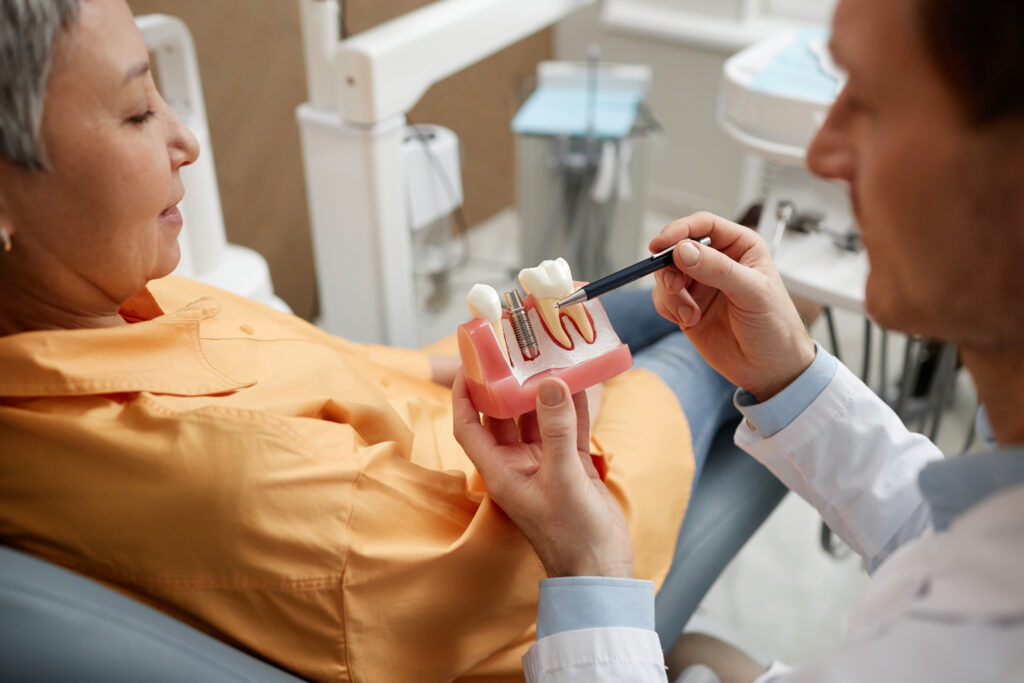
Finding out you do not have enough bone for dental implants can feel like a door slamming shut. You finally decided to do something about your missing tooth, you sat through the consultation, and then you were told your jawbone is not strong enough to support an implant. For many patients, that news lands hard. What most people are not told in that moment is that bone loss does not automatically disqualify you from getting implants. In most cases, bone graft for dental implants is a straightforward solution that rebuilds what has been lost and makes implant placement possible.
At Green Acres Family Dentistry, Dr. J. Scott Lyman and his team work with patients who have been turned away or discouraged elsewhere. Dr. Lyman takes the time to evaluate each case individually rather than giving a blanket answer based on a single scan.
Why Does Bone Loss Happen in the First Place?
When a tooth is lost, the jawbone underneath it no longer receives the stimulation it needs to maintain its density. The body essentially stops investing in that area of bone because there is no tooth root sending signals through it. This process begins within the first few months after tooth loss and continues gradually over time. The longer a tooth has been missing, the more bone volume is typically lost.
This is one of the main reasons dentists recommend replacing missing teeth sooner rather than later. Waiting years before seeking treatment is one of the most common reasons patients end up asking whether they can get dental implants with bone loss because by the time they are ready, significant resorption has already occurred.
Other causes include advanced gum disease, tooth extractions without socket preservation, trauma, and certain medical conditions that affect bone density.
What Is a Bone Graft and How Does It Work?
A bone graft for dental implants is a procedure that adds bone material to the area of the jaw where density has been lost. This creates a solid enough foundation for the implant to be placed and integrate successfully. The graft material can come from your own body, from a donor source, or from a synthetic material and all of which are well-established and widely used in dentistry.
Once the graft is placed, the body goes through a healing process where new bone cells grow into the grafted material, gradually building up the area. After that healing is complete, the implant can be placed into the newly strengthened jaw.
A common question patients ask is how painful is a bone graft for dental implants. Most patients report that the discomfort is manageable and comparable to a tooth extraction. Swelling and tenderness in the first few days are normal, and most people return to regular activity within a week.
How Long Does Healing Take?
Bone graft healing time before implant placement varies depending on the size of the graft and how quickly the individual heals. Minor grafts, such as socket preservation done at the time of an extraction, may heal in as little as three to four months. Larger grafts that rebuild a more significant area of the jaw can take anywhere from four to nine months before the site is ready for implant placement.
This timeline can feel long, but it is a necessary part of getting a result that actually lasts. Rushing placement into inadequately healed bone is one of the leading causes of implant failure. Patients searching for dental implants in Twin Falls who have been told they need a graft should understand that the wait is part of getting the outcome right, not a delay for its own sake. Our dentists serving the Twin Falls community, including patients coming in from areas like Kimberly and Jerome, take this staged approach seriously to protect long-term results.
Do You Always Need a Graft?
Not necessarily. Whether you need a bone graft depends on how much bone remains and where in the jaw the implant needs to go. Some patients who have been told they cannot get implants are actually candidates for mini implants, which require less bone volume than standard implants. Others may have sufficient bone in adjacent areas that makes placement possible without a graft at all.
The only way to know for certain is through a proper 3D cone beam scan, which gives a far more accurate picture of bone volume than a standard flat X-ray. If you have been told you cannot get implants based on a regular X-ray alone, it is worth getting a second opinion with a full imaging workup.
What Happens If You Skip the Graft and Get an Implant Anyway?
An implant placed into insufficient bone is very likely to fail. Without adequate bone surrounding it, the implant cannot integrate properly, which leads to loosening, infection, and eventual loss of the implant entirely. Beyond losing the implant itself, a failed placement can make future treatment more difficult and more expensive. Getting bone graft for dental implants done properly the first time is almost always the more cost-effective path over the long run.
At Green Acres Family Dentistry, Dr. Lyman and the team are proud to serve patients across Twin Falls and the surrounding communities. Whether you are just beginning to explore your options or have already been told your case is complicated, the right evaluation can change what is possible for you. Schedule a consultation and find out exactly where you stand.
FAQs
Do I need a bone graft for dental implants every time?
Not always. Whether a graft is needed depends on how much bone remains at the implant site. A 3D scan gives the most accurate assessment and is the best way to know for certain before making any decisions.
How painful is a bone graft for dental implants?
Most patients describe the discomfort as similar to a tooth extraction. Swelling and soreness in the first few days are normal and manageable with over-the-counter pain relief in most cases.
Can you get dental implants after bone loss without a graft?
In some situations, yes. Mini implants require less bone volume and may be an option. In other cases, the remaining bone may be sufficient depending on the location and angle of placement. This varies significantly from patient to patient.
How long after a bone graft can I get a dental implant?
Most patients wait between three and nine months depending on the size of the graft. Smaller socket preservation grafts heal faster, while larger reconstructive grafts require more time before the site is ready for implant placement.